How to Get Into the Ivy League: Advice From Ex-Harvard Admissions Officer
Justin Neiman's perspective on research extracurriculars and what actually stands out.
Published Nov 13, 2026, 08:55pm EST
Every fall, admissions offices at the most selective universities read thousands of applications from students with near-perfect grades and long activity lists. The applicants who stand out are rarely the ones with the most activities. They are the ones who did something real, finished it, and showed it to professionals who've judged it.
Justin Neiman, founder of Selective Admissions and a former Harvard admissions officer, has seen both sides of that process. His view is that presenting original research is one of the strongest ways a student can make that case, and it is the reason ThinkNeuro builds its programs around conferences.
“Presenting original research at academic conferences can help students distinguish themselves in the highly selective college admissions process. These experiences demonstrate intellectual curiosity, initiative, and the ability to communicate complex ideas beyond the classroom.”
Key takeaways
- Presenting original research at a conference is one of the clearest ways a high school student shows initiative and curiosity.
- ThinkNeuro is one of the few research programs that helps students submit to and present at undergraduate, industry and professional conferences.
- High school students who present are often the youngest people in the room, among undergraduates and medical professionals.
- Conferences are also where students meet faculty and find research positions.
Doing research is common. Presenting it is not.
Many programs help students run a project. Far fewer take them the rest of the way: turning the work into an abstract and a poster, getting it accepted, and standing next to it while professionals ask questions. ThinkNeuro is one of the few research programs built to do that last part. Interns finish with a graduate-level abstract, a research poster and an oral defense, and students in the Intensive Track also get help submitting their posters to Ivy League-hosted, industry and professional conferences, with one-on-one support and scholarships toward travel, housing and presentation fees.
The results so far: ThinkNeuro students have received 410 research conference acceptances, most of them won by high school students who then present alongside undergraduates.
The youngest person in the room
At these conferences, a high school student is often the youngest presenter by years. Their poster hangs next to posters from college researchers, and the people stopping to ask questions are undergraduates, faculty and medical professionals. Admissions readers notice that. A student who has defended original work in that setting has shown a level of maturity that grades and test scores can't.
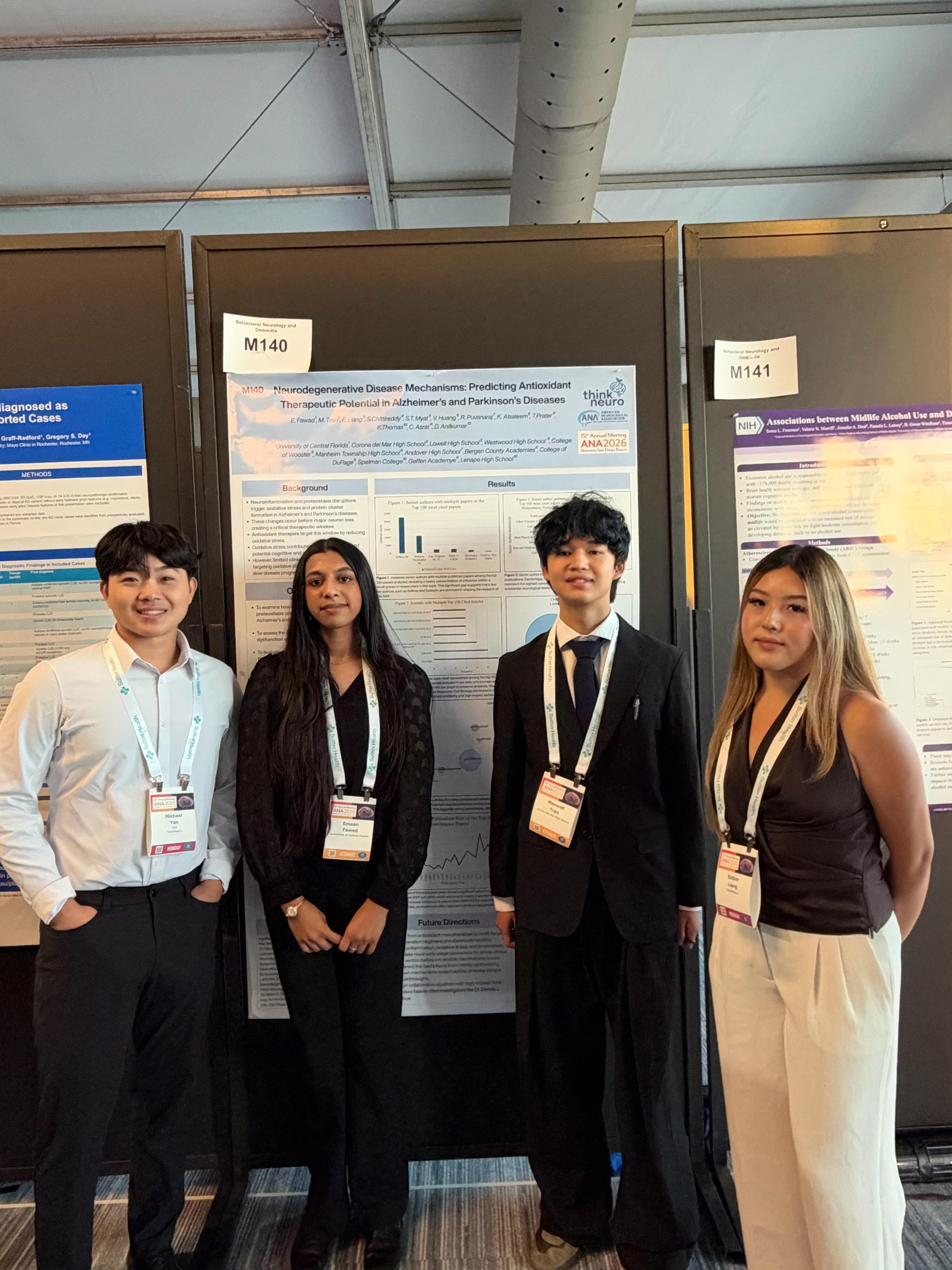

“Through ThinkNeuro, I presented research at the American Neurological Association 2026 Annual Meeting. Sharing my work in a professional scientific setting was an incredible experience that strengthened my confidence as a young researcher and deepened my passion for neuroscience.”
Published by Forbes Education, October 31, 2026.
What the admissions numbers show
ThinkNeuro was part of 384 successful applications to Ivy League and Top 20 universities, and counting. In ThinkNeuro's own data, students who presented at conferences were admitted to Ivy League and Top 20 universities at about five times the rate of students who did not, with the largest gap among high school students who presented as the youngest in a room of undergraduates or medical professionals.
Conferences are where the networking happens
A conference puts a student in front of faculty and working researchers they would never reach by cold email. A poster session gives them a reason to start a conversation, and the conversation can lead to a lab position or a summer program. For students without family connections in science, that is one of the few reliable ways in.
“ThinkNeuro introduced me to bibliometric analysis and helped me build a strong foundation in neuroscience research. I highlighted this experience in my successful application to Boston University's RISE internship program, and it helped shape the academic interests I later brought to Stanford University.”
Published by Forbes Education, October 31, 2026.
Here is how students can turn a conference into a research position:
- Read the program before you go and pick five posters or talks to visit.
- Ask one specific question about the methods or results, then listen to the answer.
- Say what you are working on in two sentences and ask what they would study next.
- Collect contact details, and send a short thank-you email within a week.
- Ask about openings: lab positions, summer programs, or someone to introduce you.
The takeaway
Admissions officers are looking for evidence that a student can start something, finish it and explain it to people who know the field. A conference presentation is that evidence in one place, and the conversations around it can open doors that a transcript can't.
“By providing students with opportunities to conduct and present their research, ThinkNeuro is establishing itself as a trusted entity in the college admissions landscape.”
ThinkNeuro's Research Internship Program is a 10-week, fully remote program that takes students from learning the methods to presenting their own research. Learn more about the program.